
Client
BuildDirect
Industry
E-commerce, building materials
Services
Technologies
Team Foundation Server
Octopus Deploy
PowerShell
Node.js

BuildDirect is a Vancouver-based online retailer of building materials such as flooring and tile, selling to homeowners and contractors through its website.
For a retailer whose storefront is software, the pace at which features reach production is a commercial question. Pricing changes, supplier integrations and checkout improvements are only worth something once customers can use them. That dependency is what brought BuildDirect to SEYA.
Project
BuildDirect had started a DevOps and digital transformation program and needed a software delivery path to match. The company's platform was built on the Microsoft stack, and the program's success depended on getting code from a developer's commit to production in a repeatable way.
BuildDirect asked SEYA's DevOps and cloud architects to help design that path. SEYA assessed the company's goals and business needs, designed a delivery pipeline on the Microsoft stack, and implemented it end to end with Team Foundation Server, Octopus Deploy, PowerShell and custom Node.js scripts.

Deliverables:
An assessment of BuildDirect's delivery goals and business needs, used to shape the pipeline design
A software delivery pipeline design on the Microsoft stack
A full software-development-lifecycle CI/CD pipeline: source control and build in Team Foundation Server, release orchestration in Octopus Deploy
PowerShell automation and custom Node.js scripts for the build, packaging and deployment steps the standard tools did not cover
The Challenge
DevOps programs stall when the tooling does not match the organization. A team on the Microsoft stack gains little from a pipeline designed around another ecosystem, and a pipeline that covers only part of the lifecycle leaves the manual steps where the delays and mistakes actually happen.
BuildDirect needed a path that its own developers would use every day: one that took a change from commit through build, test and release without hand-offs, and that fit the tools and skills already in the building. The program's leaders also needed to see delivery working in practice.
Our Expertise
SEYA began with an in-depth assessment of BuildDirect's goals and business needs. Which applications had to flow through the pipeline, how releases were approved, where environments differed, and which steps were still done by hand all shaped the design.
From that assessment SEYA designed a delivery pipeline on the Microsoft stack, choosing tools BuildDirect's engineers could own after the engagement rather than introducing a parallel toolchain.
Our Solution
SEYA implemented a full software-development-lifecycle CI/CD pipeline. Team Foundation Server holds the source and runs the builds, and Octopus Deploy orchestrates releases through environments with the promotion and approval steps BuildDirect needed.
Where the off-the-shelf tools stopped short, SEYA wrote PowerShell automation and custom Node.js scripts, so packaging, configuration and deployment steps that would otherwise have been manual are part of the pipeline and run the same way every time.
Value Delivered
For an IT manager or head of engineering, the change is in where effort goes. Deployments stop being events that need the right person available and become a pipeline step anyone on the team can trigger and trace.
Because the pipeline covers the whole lifecycle, there is one record of what was built from which commit and where it was deployed. That is what an auditor, a support engineer or a product owner asks for when something goes wrong or a feature needs to be verified in production.
Building on tools the team already used meant the pipeline could be maintained in-house after the engagement, which is the point at which a DevOps program becomes a way of working rather than a project.
The Result
BuildDirect's developers could move features through the new pipeline from commit to release, on the Microsoft stack they were already working in.
The pipeline gave the company's DevOps program a working delivery path it could build on, with build, release and the surrounding automation defined in Team Foundation Server, Octopus Deploy, PowerShell and Node.js.
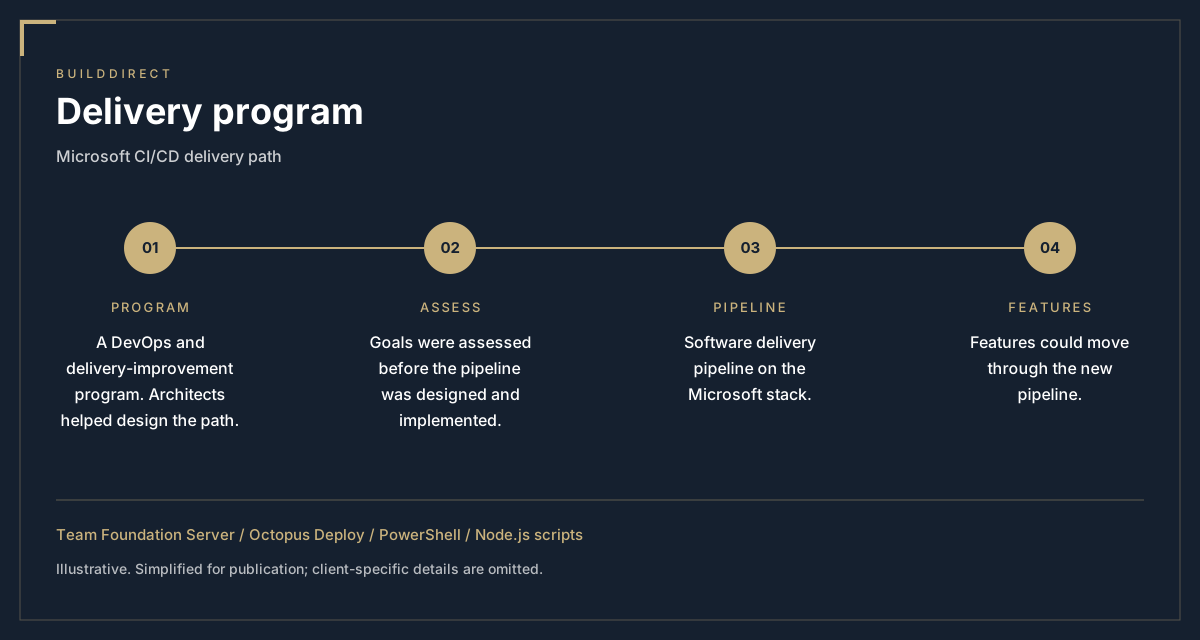
Illustrative: the assessment sits between the program decision and the pipeline build, so the toolchain was chosen to fit BuildDirect rather than the other way round.
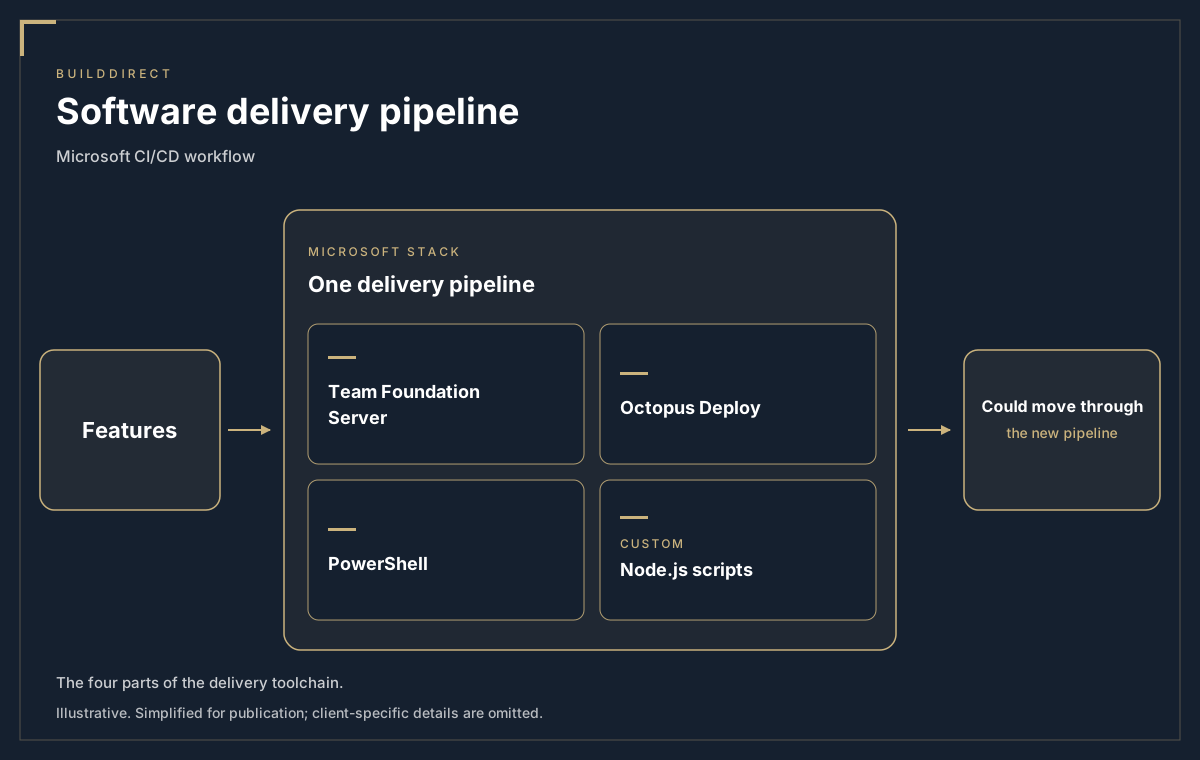
Illustrative: the four parts are shown as one pipeline; the custom Node.js scripts fill the gaps between the standard Microsoft tools.
Releases on your Microsoft stack still depend on a checklist and the right person being in?
SEYA can assess your delivery path and build a CI/CD pipeline your own team will run. Write to hello@seyagroup.io to arrange a conversation.
Contact us
Send an enquiry about a cloud, platform, data, or reliability engagement. Marketing email is a separate choice on the form.