
Client
Boeing
Industry
Aerospace, aircraft maintenance services
Technologies
Microsoft Azure
Docker
Kubernetes
WaveFlux
Terraform
Packer
Ansible

Boeing is an aerospace manufacturer. GoldCare is its maintenance, repair and overhaul service for airlines operating the 787 Dreamliner: the software behind it supports the maintenance records and services those operators rely on.
An application in that position cannot be moved casually. Its data is sensitive and the people who depend on it are keeping aircraft in service. Any migration has to satisfy the client's information security team before a single workload goes live.
Project
Boeing InfoSec vetted the Azure infrastructure for GoldCare, the 787 maintenance application, before it went live. SEYA provisioned that infrastructure in 2016 and connected it to on-premises databases that stayed in Colorado.
By 2016 the GoldCare application stack was running on legacy infrastructure spread across several locations. Boeing Development wanted the elasticity, scalability, security and reliability of a public cloud, chose Azure, and asked SEYA to carry out the migration.
SEYA proposed a containerized platform built from code, provisioned the Azure infrastructure, took it through Boeing InfoSec review, deployed the GoldCare stack, connected it to the on-premises databases that had to stay in a Colorado data centre, and ran the data migration for the stack.

Deliverables:
Azure infrastructure provisioned by SEYA and vetted by the Boeing InfoSec team
A proposal covering containerization with Docker, orchestration with Kubernetes, WaveFlux as the code repository, Terraform and Packer for infrastructure, and Ansible for configuration
Deployment of the GoldCare application stack on Azure
A hybrid connection from the Azure stack to on-premises databases in a Colorado data centre
Data migration for the GoldCare stack
The Challenge
Infrastructure that has grown across locations over many years is expensive to change and hard to reason about. Capacity cannot be added quickly, every environment is slightly different, and security reviews have to be repeated for each site. For a service supporting a commercial aircraft fleet, those constraints become a business risk rather than an IT inconvenience.
Boeing Development decided to move the GoldCare infrastructure to Azure to get elastic capacity, a platform that could scale with the service, and a security and reliability posture it could stand behind. The engagement had two conditions that shape any migration of this kind: the Boeing InfoSec team had to vet the infrastructure, and some databases had to remain on premises in Colorado and stay reachable from the cloud.
Our Expertise
SEYA's proposal treated the migration as a platform build rather than a server move. Application components would be packaged in Docker containers and run under Kubernetes, so the stack could be deployed the same way in every environment and scaled by adding nodes rather than rebuilding servers.
Infrastructure would be defined in Terraform, with machine images built by Packer and configuration applied by Ansible, and all of it held in WaveFlux as the code repository. Defining the environment in code meant the InfoSec team could review what would be built before it existed, and the same definitions could be rebuilt or audited later.
Our Solution
SEYA provisioned the Azure infrastructure and took it through review with the Boeing InfoSec team before the application landed on it. With the platform approved, SEYA deployed the GoldCare application stack to Azure.
The databases that remained in the Colorado data centre were connected to the Azure environment, so the application could run in the cloud while continuing to read and write against on-premises data. SEYA then ran the data migration described for the stack.
The result was a hybrid arrangement: application tier on Azure, selected databases on premises, with the whole platform described in code that the client's teams could inspect.
Value Delivered
For a CIO weighing a similar move, the value is in how the risk was handled. Security review happened on infrastructure defined in code, before deployment, rather than as an inspection of a finished environment. That is a repeatable pattern for any organization whose InfoSec function has veto power over production changes.
Keeping specific databases on premises and connecting them to the cloud tier removed the need to migrate everything at once. Teams could gain Azure's elastic capacity for the application while data governance stayed where it was.
Containers and infrastructure as code gave Boeing Development a platform that can be rebuilt, scaled and audited from its definitions, instead of a collection of hand-configured servers across locations.
The Result
The GoldCare application stack runs on Azure infrastructure that passed Boeing InfoSec review, connected to the on-premises databases in Colorado, with its data migrated.
Boeing Development has the cloud platform it set out to get: elastic capacity for the application tier, a containerized deployment model, and an environment defined in Terraform, Packer and Ansible rather than spread across legacy sites.
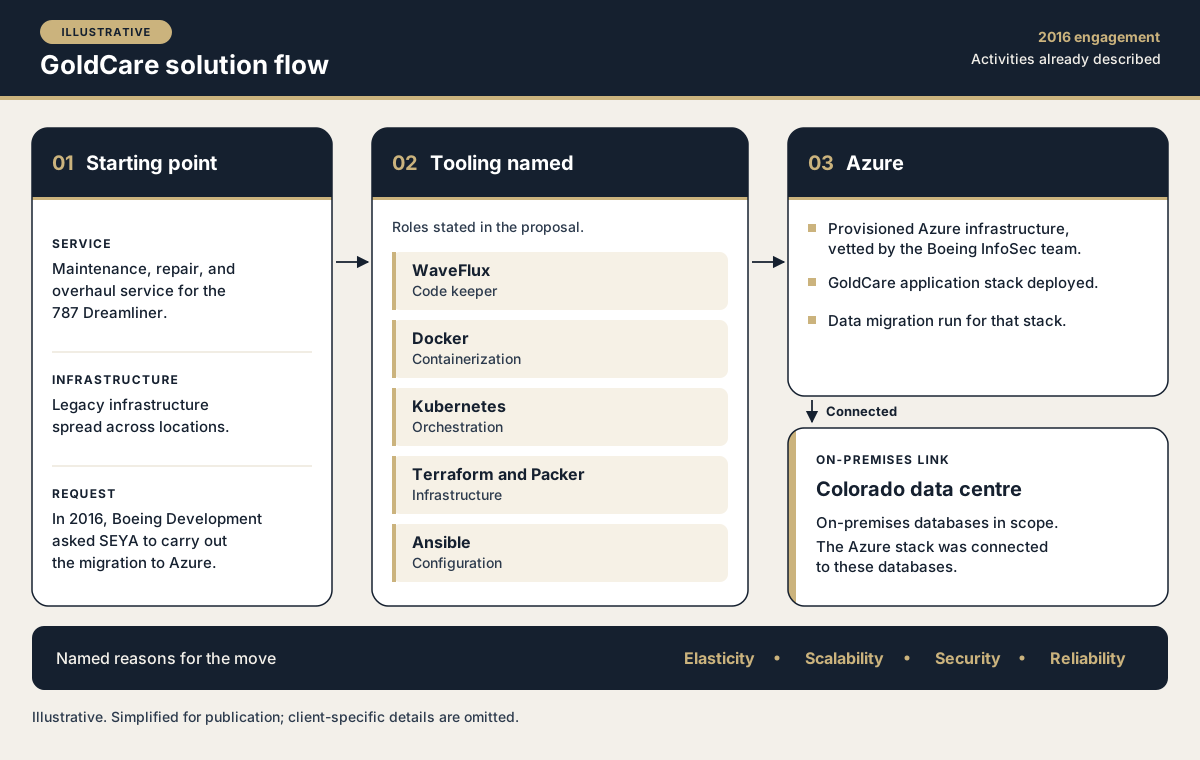
Illustrative: the on-premises databases stay in Colorado and connect to the Azure application tier, which is what makes this a hybrid migration rather than a full move.
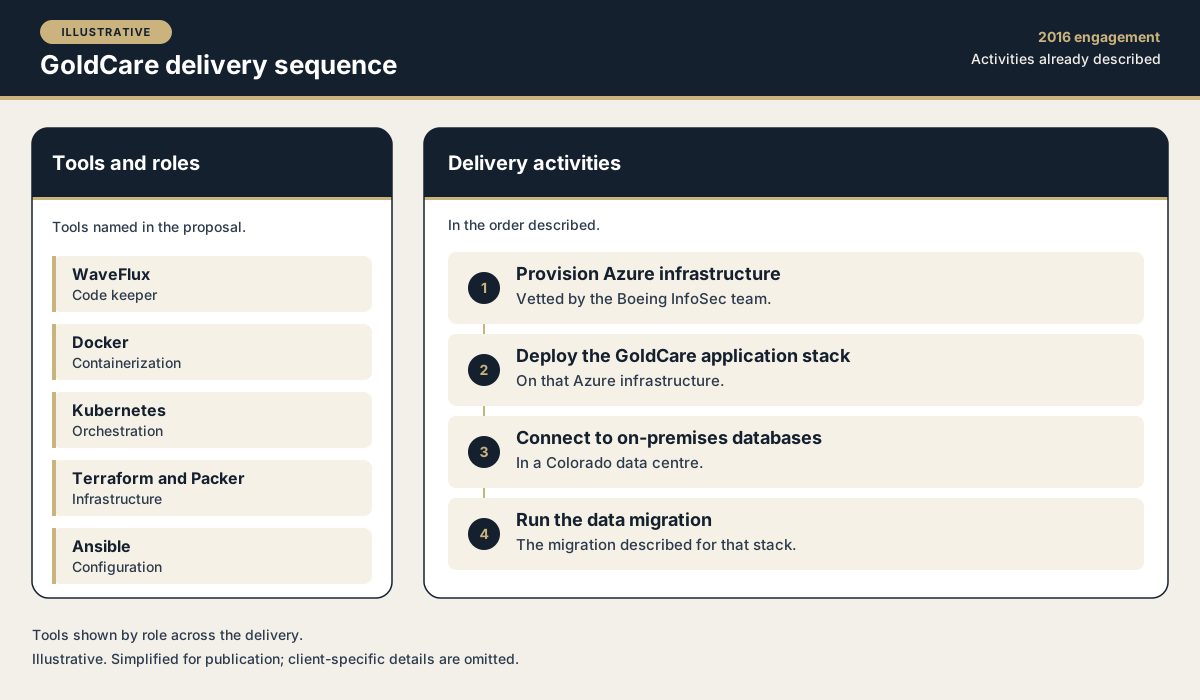
Illustrative: InfoSec review sits at step one, before deployment, so security sign-off happens on infrastructure defined in code rather than after the fact.
Moving a regulated or security-sensitive application to Azure?
SEYA can scope a migration that keeps your InfoSec team in the review loop and leaves selected data on premises. Start the conversation at hello@seyagroup.io.
Contact us
Send an enquiry about a cloud, platform, data, or reliability engagement. Marketing email is a separate choice on the form.